Families looking for an International School Bangkok often encounter several curriculum choices. Among the most established options is the British curriculum, which is used by international schools in many countries and provides a structured pathway from the early years through Secondary and pre-university education.
For parents, however, seeing the phrase “British curriculum” on a school website is only the beginning. Schools can follow similar curriculum frameworks while offering very different approaches to teaching, pastoral care, extracurricular activities, facilities, and school culture.
Understanding how British education works can therefore help parents compare schools more effectively.
What Is the British Curriculum?
The British curriculum is broadly based on the educational system of England and provides learning progression across different age groups.
The exact structure varies between international schools, but parents may encounter stages including:
- Early Years
- Primary or Prep School
- Secondary or Senior School
- IGCSE
- Sixth Form
- A Levels
The progression allows pupils to develop broad foundations when they are younger before moving towards greater subject specialisation in later years.
Why Do Parents Consider British International Education?
There are several reasons families may consider a British curriculum.
One is the structured progression between year groups.
Parents can understand what pupils are expected to develop at different stages and how earlier learning connects with later qualifications.
Another reason is the international familiarity of qualifications commonly associated with British education.
Families who may relocate between countries can also value an education system used by international schools around the world.
However, curriculum structure alone should never be the only reason for choosing a particular International School Bangkok.
Early Years: Building the Foundations
For younger children, education should provide more than early academic instruction.
The Early Years are an important period for developing:
- Communication
- Independence
- Social skills
- Curiosity
- Physical development
- Creativity
- Emotional confidence
Learning Through Play
High-quality Early Years environments often use purposeful play and exploration to introduce children to language, mathematics, creativity, and the world around them.
Developing Independence
Simple routines such as choosing activities, organising belongings, communicating needs, and working with classmates can help young children become more confident learners.
Parents visiting an Early Years setting should therefore look beyond worksheets or academic displays and observe how children interact with adults, classmates, and the environment.
Primary Education: Developing Broad Skills
As pupils progress through Primary education, learning becomes increasingly structured.
Core subjects generally become more developed, while pupils continue to explore broader areas such as languages, humanities, art, music, physical education, and technology depending on the school.
An effective Primary programme should help children develop not only knowledge but also learning habits.
These may include:
- Asking questions
- Solving problems
- Working collaboratively
- Communicating ideas
- Reading independently
- Applying mathematical thinking
- Developing creativity
Parents should ask how teachers identify individual strengths and areas where additional support may be needed.
Secondary School: Increasing Academic Depth
The transition into Secondary education usually brings greater subject specialisation.
Students may begin working with specialist subject teachers and studying more complex material.
At this stage, families researching an International School Bangkok should explore the range of subjects available and how pupils are supported in making academic choices.
It is also worth understanding the school’s approach to homework, assessment, academic support, and pastoral care.
Teenagers are developing academically, socially, and emotionally at the same time, so a strong Secondary programme should recognise all three areas.
What Are IGCSEs?
IGCSE stands for International General Certificate of Secondary Education.
These qualifications are commonly associated with British international schools and are typically studied during the Secondary years.
Students usually take a combination of compulsory and optional subjects.
Why Subject Choice Matters
A broad selection of IGCSE subjects can help pupils explore their interests before deciding which areas to specialise in later.
Parents should ask:
- Which subjects are available?
- When do pupils select them?
- How does the school advise families?
- Are there prerequisites for particular Sixth Form subjects?
The quality of academic guidance is particularly important when students begin making choices that may affect later university pathways.
What Are A Levels?
A Levels are pre-university qualifications commonly offered within British education.
Students typically specialise in a smaller number of subjects than during IGCSE.
This allows them to develop greater depth in areas connected with their strengths and potential degree choices.
For example, a pupil considering engineering may focus heavily on mathematics and sciences, while a pupil interested in humanities may choose subjects such as history, economics, literature, or languages.
University Preparation Should Start Before the Final Year
Families with older pupils should ask how schools support university preparation.
University guidance may involve:
- Subject selection
- Career exploration
- University research
- Application planning
- Personal statements
- Interview preparation
- Admissions testing where required
The strongest approach helps pupils identify both their interests and realistic academic pathways.
Rather than waiting until the final months before applications, university preparation should develop progressively.
British Curriculum Does Not Mean Every School Is the Same
This is one of the most important points for parents to understand.
Two schools can both follow a British educational framework and still offer very different experiences.
Differences may include:
- Teaching style
- Class size
- Academic expectations
- Pastoral care
- Extracurricular programmes
- Facilities
- School culture
- Languages
- Subject choices
- University guidance
Therefore, parents searching for an International School Bangkok should compare the quality of the complete school experience, not simply the curriculum label.
The Importance of Pastoral Care
Pastoral care refers broadly to the support provided for a pupil’s wellbeing and personal development.
Children may face challenges involving friendships, academic pressure, confidence, transitions, or adapting to a new school.
Parents should ask:
Who Supports the Child?
Understand who pupils can speak to if they experience a problem.
How Are Parents Informed?
Find out how teachers communicate academic, social, or wellbeing concerns.
How Does the School Handle Transitions?
This can be particularly important for families moving between countries or transferring from another educational system.
A child who feels secure and supported is more likely to engage positively with learning.
Extracurricular Education Matters
British education should not be understood as examination preparation alone.
A broad school experience can include sport, art, music, drama, design, technology, leadership, competitions, clubs, and community programmes.
These opportunities can help pupils develop:
- Teamwork
- Creativity
- Resilience
- Communication
- Confidence
- Leadership
- New interests
Families should look at whether extracurricular programmes are genuinely integrated into school life rather than simply appearing on a list.
What Facilities Should Parents Look For?
The importance of a facility depends on whether pupils actually use it.
During a school tour, parents can explore spaces such as science laboratories, libraries, sports facilities, performance areas, art studios, music rooms, technology areas, and outdoor learning environments.
Ask How the Facilities Support Learning
Instead of asking only whether a school has a theatre, ask how frequently pupils perform.
Instead of asking whether it has laboratories, ask when children begin practical science work.
This changes the conversation from what a school owns to what pupils experience.
Compare Location Alongside Curriculum
Bangkok families must also think practically.
Even if parents strongly prefer a British curriculum, a school with an extremely difficult commute may create challenges for daily life.
Consider:
- Morning journey time
- Afternoon traffic
- After-school activities
- Homework
- Sleep
- Family time
Try travelling to shortlisted schools during realistic school hours before making a final decision.
Compare the Full Cost of International Education
Parents should request the complete fee schedule rather than comparing only tuition.
Additional costs may include registration, meals, transport, uniforms, examination charges, trips, learning resources, and extracurricular programmes.
Calculate an estimated annual cost for each shortlisted school.
This makes commercial comparison more meaningful and allows families to plan for the longer term.
Brighton College Bangkok and British Education
Parents looking for a British international school in Bangkok can research Brighton College Bangkok alongside other schools when comparing curriculum, academic pathways, extracurricular education, location, admissions, and the overall learning environment.
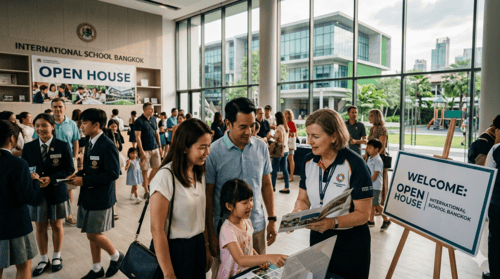
Online information is useful for initial research, but families should contact admissions teams directly for current information and arrange a visit when they have created a shortlist.
A school tour is especially useful because British curriculum schools can differ considerably despite sharing the same broad educational framework.
Questions to Ask a British International School
What curriculum pathway do pupils follow?
Ask how education progresses from the Early Years through Secondary and Sixth Form.
Which qualifications are available?
Parents of older children should explore IGCSE and pre-university options.
How are pupils assessed?
Understand how teachers monitor progress and communicate it to families.
How broad is the extracurricular programme?
Ask about sport, music, art, drama, technology, clubs, and leadership.
How does the school support university applications?
This is particularly important for families with Secondary or Sixth Form pupils.
Final Thoughts
Choosing a British curriculum International School Bangkok requires more than checking whether the school follows a familiar educational system.
Parents should look at the quality of teaching, academic progression, pastoral care, extracurricular opportunities, facilities, university preparation, school culture, location, and fees.
The goal is not simply to choose a curriculum.
It is to find a school where the curriculum is delivered in a way that supports the individual child academically, socially, creatively, and personally.
Families who combine online research with detailed conversations and campus visits will be in a stronger position to make an informed choice.
FAQ About British Curriculum Schools in Bangkok
What is a British curriculum international school?
It is generally an international school that follows an educational pathway based on the British system, potentially including Early Years, Primary, Secondary, IGCSE and A Levels.
Is the British curriculum suitable for university abroad?
British qualifications are used by pupils applying to universities internationally, although entry requirements should always be checked for individual universities and courses.
Is British curriculum better than IB?
Neither is universally better. The appropriate curriculum depends on the pupil’s learning style, interests, strengths, and future plans.
What should parents compare between British international schools?
Compare teaching, subject choices, pastoral care, activities, facilities, location, fees, class environment, and academic pathways.
Should families visit the school before applying?
Yes. A school visit helps families understand how the curriculum is delivered in practice and whether the overall environment suits the child.